Voyage and court
A dated line from New York to Gibraltar.
The dates below are taken from Royal Museums Greenwich, with Fay’s court-paper details and a contemporary press date kept in view where they differ.
- 7 November 1872The brigantine Mary Celeste left New York on 7 November 1872, heading for Genoa, Italy.1 On board was Captain Benjamin Briggs, his wife Sarah and their two-year-old daughter Sophia.1 Briggs’s crew numbered seven: first mate Albert Richardson, second mate Andrew Gilling, steward William Head, and seamen Gottleib Gouldschaal, Arian Martens, and brothers Boz and Volkert Lorenzen.1 The ship was carrying around 1,700 barrels of high-grade alcohol.1
- Morning of 25 NovemberThe log slate had been left behind, bearing a final entry for the morning of 25 November.1 Fay’s 1942 publication of the court papers records the last entry on the vessel’s log slate as dated 8 a.m., 25 November, reading “Eastern point of St. Mary’s bore 6 miles SSW.”2
- 4 December 1872On 4 December 1872, the crew of the brigantine Dei Gratia sighted a ship adrift in the Atlantic near the Azores.1 Fay records the position where the Dei Gratia found the Mary Celeste as latitude 38° 20′ N, longitude 17° 15′ W.2
Sources differ. Royal Museums Greenwich dates the Dei Gratia’s sighting to 4 December 1872. Some later accounts use 5 December. One explanation, often given, is the difference between civil time and the sea time then kept on board; both dates stay in view here, and the main statement follows the museum.
- 12–13 DecemberDeveau and his men arrived at Gibraltar on 13 December, the day after Morehouse and the Dei Gratia.1
- 17 December 1872 – 25 February 1873A salvage court convened on 17 December. The proceedings continued until 25 February.1 Frederick Solly-Flood, the Attorney General for Gibraltar, remained convinced that the cause of the abandonment was foul play.1
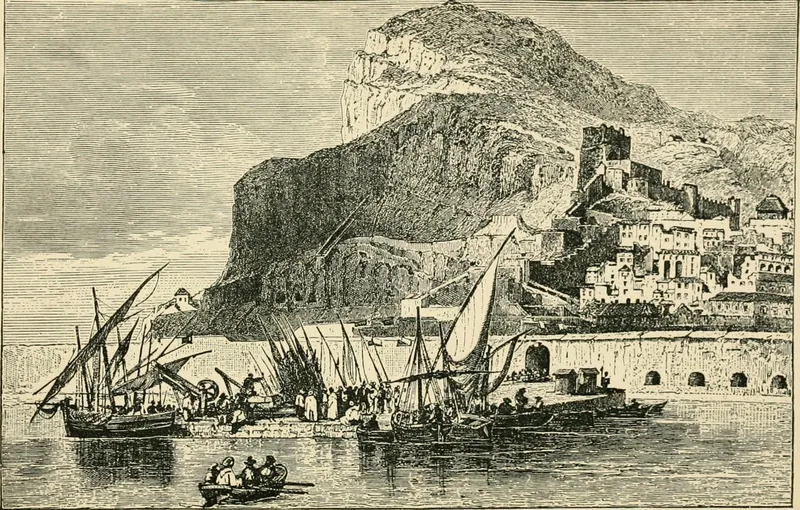
The engraving is a view of the harbour published in 1879, a few years after the hearing. It is not a picture of the Mary Celeste herself.
Sources differ. The Boston Post report reprinted in the New York Times of 26 February 1873 says the brig left New York on the 17th of November. Royal Museums Greenwich gives 7 November 1872. The press date is treated here as a contemporary report, not as a correction of the museum’s figure.
The same Boston Post report said the brig left New York on the 17th of November for Genoa — a date that does not match the 7 November departure given by Royal Museums Greenwich.3