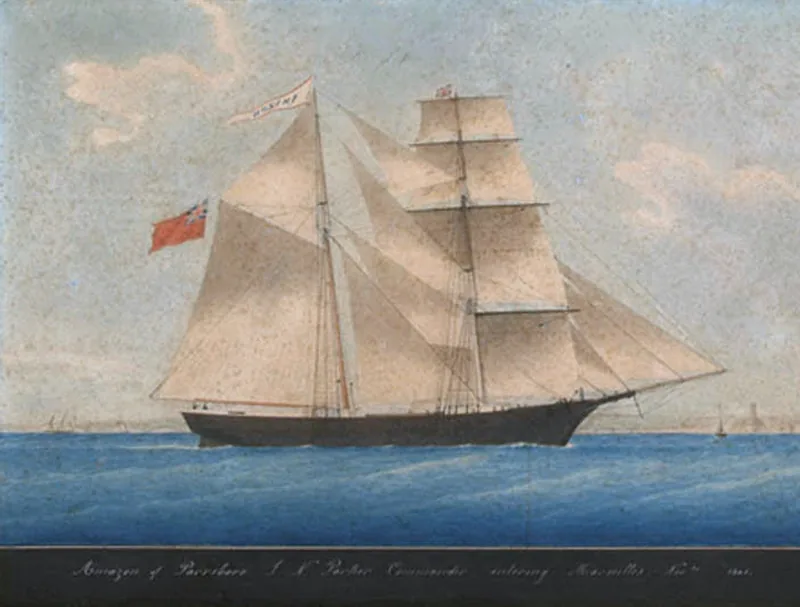
The short version
The brigantine Mary Celeste left New York on 7 November 1872, heading for Genoa, Italy.1 On board was Captain Benjamin Briggs, his wife Sarah and their two-year-old daughter Sophia.1 Briggs’s crew numbered seven: first mate Albert Richardson, second mate Andrew Gilling, steward William Head, and seamen Gottleib Gouldschaal, Arian Martens, and brothers Boz and Volkert Lorenzen.1 The ship was carrying around 1,700 barrels of high-grade alcohol.1
On 4 December 1872, the crew of the brigantine Dei Gratia sighted a ship adrift in the Atlantic near the Azores.1 The Mary Celeste was completely deserted.1 The only clue as to the whereabouts of her crew was the missing boat, which was normally stowed over the main hatch.1
Sources differ. Royal Museums Greenwich dates the Dei Gratia’s sighting to 4 December 1872. Some later accounts use 5 December. One explanation, often given, is the difference between civil time and the sea time then kept on board; both dates stay in view here, and the main statement follows the museum.
The people on board — Briggs, his wife and child, and a crew of seven — are treated here as real people, not as characters in a ghost story. For the hour-by-hour record of a different peacetime tragedy, see titanic.nautical.im. For working lights and how a character is read, see lighthouses.nautical.im. Both sit in the nautical.im collection. There is also a page on who was on board, and one on the name Mary Celeste, not Marie Celeste.