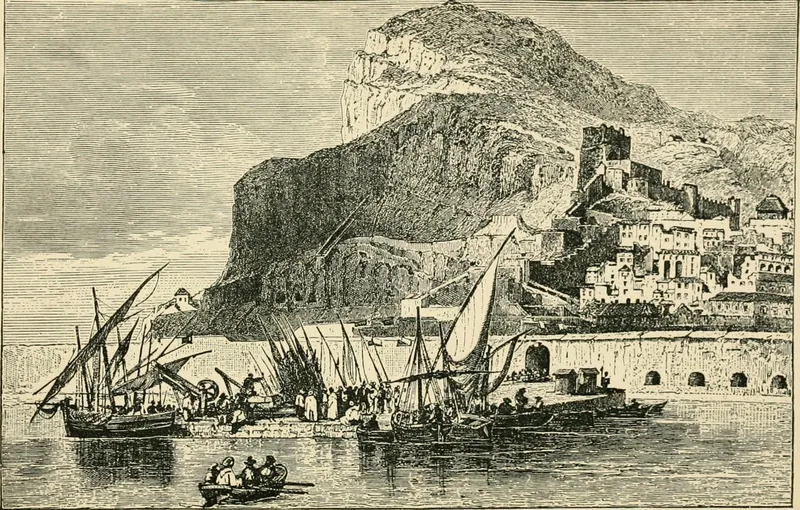
Gibraltar
The salvage court, the survey and the chemist.
Deveau and his men arrived at Gibraltar on 13 December, the day after Morehouse and the Dei Gratia.1 A salvage court convened on 17 December. The proceedings continued until 25 February.1 Frederick Solly-Flood, the Attorney General for Gibraltar, remained convinced that the cause of the abandonment was foul play.1
Austin’s survey
Austin found, on the port bow, a long narrow strip of plank recently cut away, which in his opinion could not have been effected by the weather and was apparently done by a sharp cutting instrument.2 Under the forehatch Austin found a new hawser which had never been used and was perfectly dry.2 Provisions on the cabin floor — including flour, tea and dried herrings — were perfectly dry and had not been in the slightest degree injured or affected by water.2 Austin observed in the cabin a sword in its scabbard; on drawing the blade it appeared to him as if it had been smeared with blood and afterwards wiped.2 Austin found one of the pumps in good order; the valve of the other had been removed for the purpose of passing a sounding-apparatus into the well, and the sounding apparatus was lying near and in good order.2 Austin made a careful examination and did not discover the slightest trace of there having been any explosion or any fire, or of anything calculated to create an alarm of an explosion or of fire.2 Having considered the diver’s affidavit as well as his own survey, Austin was wholly unable to discover any reason whatever why the vessel should have been abandoned.2
Austin’s opinion about a sharp cutting instrument on the bow, and his first impression of the sword, are his. They are not treated here as a finding of violence. The chemist’s report is the test that the court asked for.
Dr Patron’s report
Dr J. Patron concluded that, according to the scientific knowledge of 1873, there was no blood either in the stains observed on the deck of the Mary Celeste or on those found on the blade of the sword he examined.3
Patron wrote that his first impression of some stains on the blade was that they were really blood stains, and that the tests were of a negative character. His signed conclusion is that there was no blood on the deck or on the sword.