Later stories
What the papers, and a short story, added.
Two later accounts did more than anything in the court file to fix the popular picture of the ship. Both are given here in their own words, and then set beside the record.
The Boston Post, February 1873
The New York Times of 26 February 1873, reprinting the Boston Post of 24 February, reported it as then believed that the Mary Celeste had been seized by pirates, and that the captain, his wife, child and officers had been murdered.1 The general opinion, the Boston Post said, was that there had been foul play on board, citing spots of blood on a sword and on the rails, and a sharp cut on the wood.1 The same Boston Post report said the brig left New York on the 17th of November for Genoa — a date that does not match the 7 November departure given by Royal Museums Greenwich.1
The report also calls the Dei Gratia a British brig. Other accounts describe her as a Canadian vessel out of Nova Scotia. The cutting is a contemporary opinion, not a finding of the court.
Conan Doyle, 1884
Conan Doyle’s story opens on the British ship Dei Gratia steering into Gibraltar, having in tow the derelict brigantine Marie Celeste.2 Arthur Conan Doyle’s fictitious “J. Habakuk Jephson’s Statement,” published in the 1880s, is riddled with factual inaccuracies that are still sometimes taken as fact, including the misspelling of the ship’s name as Marie Celeste.3 The name of the vessel in the United States registers, from the American flag register of 31 December 1868 onwards, was Mary Celeste, not Marie Celeste.4
The story is fiction. It changed the name, and it is still the source of details that readers sometimes take as fact.
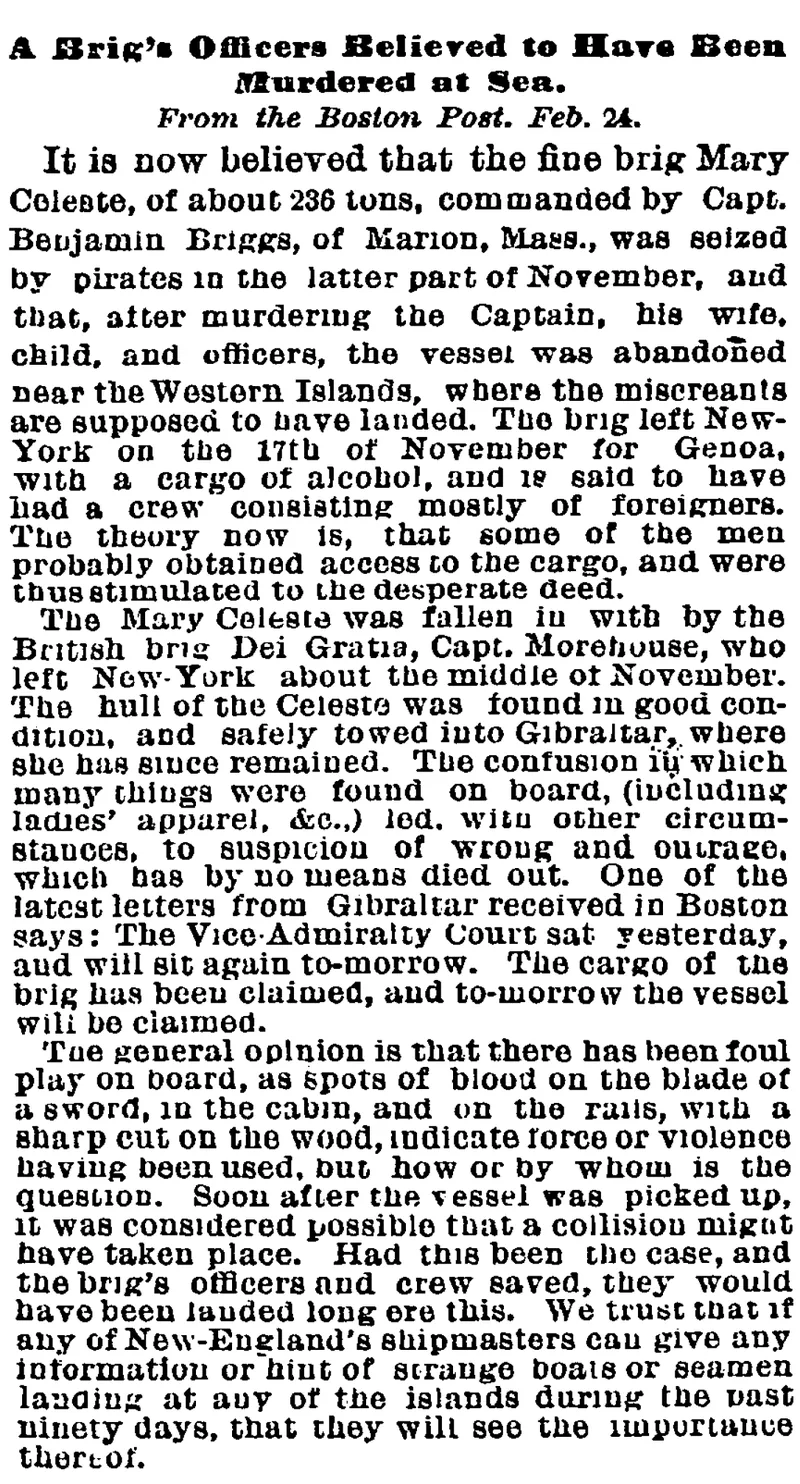
The column as printed on 26 February 1873. Use it as a record of what was being said, including a departure date that does not match the museum’s figure, not as a narrative of what happened on board.